Eyebrow/ Forehead Lifting
Eyebrow and Forehead Lifting addresses eyebrow
position and loose or wrinkled forehead skin and underlying tissue. To fully understand the benefits of eyebrow and forehead
lifting, one must be aware of the importance of the position of the eyebrows.
Eyebrow position changes as we age. Our natural eyebrow position, the effects of gravity and
fat deflation, how active our eyebrow and forehead muscles are, and previous eyelid, eyebrow or forehead surgeries (if applicable),
all contribute to the position our eyebrows are in today. The face sends a message, and the position of the eyebrows is a
significant part of that message. That message could be, "I feel worried,” “I feel angry,” or “I
feel stressed.” The message could also be, “I feel calm, rested, and relaxed.”
There are several
types of eyebrow and forehead lifts. The type you and your surgeon choose will depend on your current eyebrow position, facial
structure, and on what is possible to maximize your appearance. The main types of forehead lifting are as follows:
The Endoscopic Eyebrow/ Forehead Lift
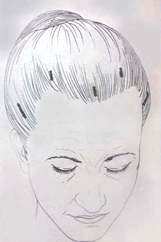
The Endoscopic Eyebrow/ Forehead Lift is very popular. It requires 5 small incisions hidden
in the hair and leaves no visible scar. This procedure can lift everything from the hairline to the eyebrows. It tightens
and smoothes the entire forehead while lifting the eyebrow area which “opens up” the entire upper face. Eyebrow
shape and asymmetry can be addressed with this type of lift. Following the procedure there will be some bruising and swelling.
Patients are usually comfortable returning to their normal routine activities in about 2 weeks.
The
Pretrichial Eyebrow/ Forehead Lift
The Pretrichial Eyebrow/ Forehead
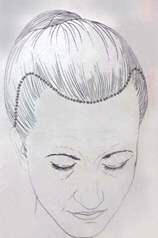
Lift requires a long incision. This procedure is ideal for patients who want to both lift the eyebrows and raise and shorten
the forehead by removing a strip of skin and underlying tissue along the incision. Because the forehead is shortened, the
hairline is lowered which is ideal for those with a high forehead. This procedure lifts everything from the hairline down
to the eyebrows and can address eyebrow shape and asymmetry. The scar from the incision, once healed, is virtually undetectable.
Following the procedure there will be some bruising and swelling. Patients usually return to their normal daily routine in
2 – 3 weeks.
The Gull Wing Eyebrow/ Forehead Lift
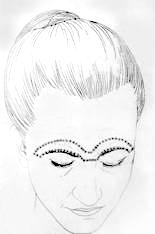
The “Gull Wing” or Direct Brow Lift requires removing a
section of skin and underlying tissue above and following the length of the eyebrows. This procedure is ideal for those who
do not want to involve the hairline. The “Gull Wing” beautifully lifts a sagging brow while tightening and smoothing
the forehead by pulling the skin and tissue of the forehead down rather than up. It therefore lowers the hairline which is
ideal for a receding hairline and/ or a high forehead. This procedure also addresses eyebrow shape and asymmetry. Care is
taken to position the scar just along the eyebrows so that it is maximally camouflaged as shown below. Patients will experience
some bruising and swelling following the procedure. They are usually comfortable returning to their normal routine activities
in about 2 weeks.
BEFORE
AND AFTER PHOTOS
The Endoscopic Eyebrow/Forehead Lift
|
|
| Before endoscopic forehead lift the patient has an angry look due to low medial eyebrow position. |
|
|
| After surgery the patient looks refreshed and rested. |
The Pretrichial Eybrow/ Forehead Lift
|
|
| Before pretrichial forehead lift the patient has lax skin and a high forehead. |
|
|
| The patients brows are now raised, forehead is smoothed & hairline lowered. Excess skin was removed. |
The "Gull Wing" Eyebrow/Forehead Lift
|
|
| Before gull wing eyebrow/forehead lift surgery. |
|
|
| After: The patient's brows are raised and forehead is smoothed. Excess eyelid skin was also removed. |
Who Should Perform Eyebrow/
Forehead Lifting Surgery?
When choosing a surgeon to perform an Eyebrow/ Forehead Lift, look for a cosmetic and reconstructive facial surgeon
who specializes in the eyelids,
orbit, and the adjacent structures such as the eyebrows, forehead, cheeks and midface. It’s also important that he or she has completed an American Society of Ophthalmic Plastic and Reconstructive Surgery (ASOPRS) fellowship. This indicates your surgeon is not only a board
certified ophthalmologist who knows the anatomy and structure of the eyelids and orbit and all surrounding
areas, but also has had extensive training in ophthalmic plastic
reconstructive and cosmetic
surgery. Dr. Shorr is Director of the Fellowship in Ophthalmic Plastic Reconstructive and Cosmetic Surgery
at the Jules Stein Eye Institute, UCLA School of Medicine. He and his associates are board certified ophthalmologists as well
as ophthalmic plastic reconstructive and cosmetic facial surgeons who have completed an ASOPRS fellowship.
Dr. Norman Shorr is an early pioneer
and innovator of many cosmetic and reconstructive eyelid, eyebrow, forehead and midface procedures performed today worldwide.
He and our surgeons continue to innovate and contribute to the specialty of cosmetic
and reconstructive facial
surgery. Call today to schedule your personal consultation!
_____________________________
Scheduling a consultation is easy!
(310) 278-1839
or via email
drshorr@pacbell.net